
RETHINKING CHANGE
STREET EXPERIMENTS FOR MOBILITY TRANSITIONS
Are you interested in accelerating the sustainable mobility transition? Rethinking Change is a hybrid- masterclass that bridges the gap between academia and practice to achieve exactly that. Through a blend of at-home learning and live facilitated workshops you unlearn old ways of thinking, seeing and working that are in the way of real, transformative change. And you replace them with new lenses and practices that actually work.
Developed together with HumanKind and the University of Amsterdam, this course focuses on understanding and driving change through deep reflection, strategic organisational planning, and human-centric design. It bridges the gap between academic theory and day-to-day practice, putting you in the driver seat for the sustainable mobility transition.
WHO IS THIS COURSE FOR?
This is a course for planners, practitioners, and urbanists passionate about transforming our mobility system. This is a hands-on, practical course where you will have the opportunity to workshop your own mobility project or wild idea.
If you are unfamiliar with the concept of mobility transitions, we recommend you start first with our online course Reclaiming the Street for Livable Urban Spaces.
This program gives you:
ACTIONABLE FRAMEWORKS FOR ANY CONTEXT
Walk away with ready-to-use templates for Transformative Change, Conflict Management, Cognitive mapping strategies and Belonging design, equipped with an applicable tool-kit.
LINK BETWEEN THEORY AND PRACTICE
Grounded in cutting-edge academic research, this course builds a seamless bridge between complex theoretical concepts, real-world case studies and input, and hands-on tools that actually work in practice.
TIME-EFFICIENT DEVELOPMENT
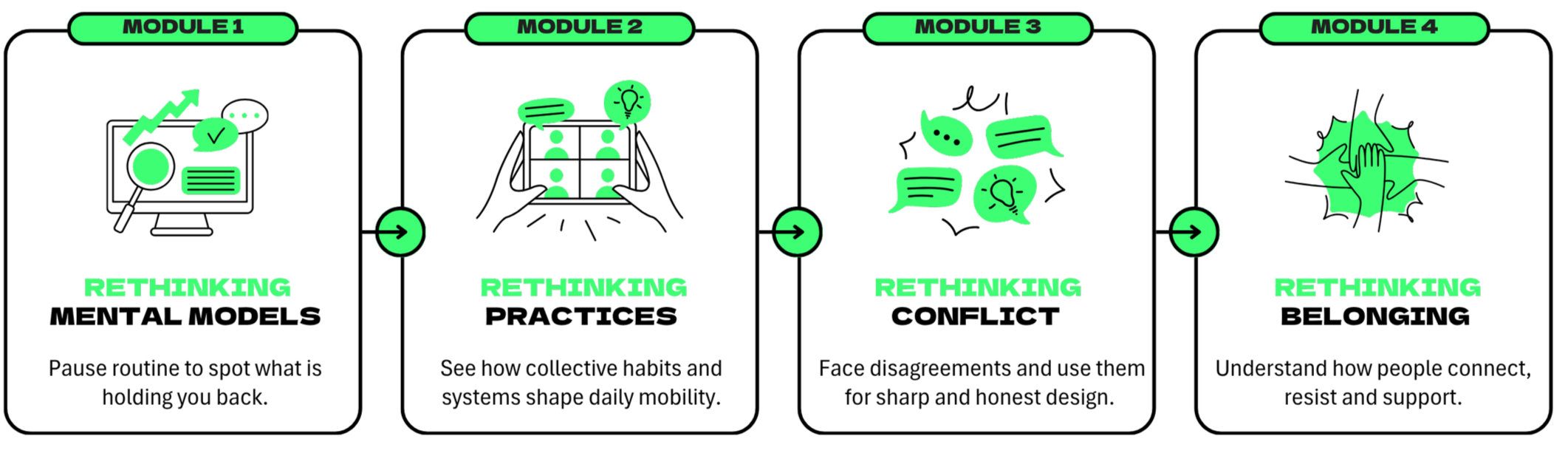
Four focused modules designed to fit into busy schedules without sacrificing depth, blending flexible at-home learning with online, facilitated workshops.
Marco te Brömmelstroet
University of Amsterdam
Lior Steinberg
HumanKind

Program content
1. RETHINKING WORLDVIEWS
‘Sometimes, you have to slow down to speed up.’
When urban transformation projects get stuck, it is rarely due to a lack of effort. More often, it is because we are held back by invisible, deep-rooted routines and organizational cultures.
In this first module, we invite you to hit PAUSE on your everyday autopilot. Together, we will step into structured reflection, uncover the "hidden commitments" blocking change, and equip you with the exact tools needed to get your project unstuck.
LEARNING OBJECTIVES
By the end of this first module, you will be able to:
Step Out of Autopilot: Take a strategic step back from daily routines to critically reflect on your project's true direction.
Diagnose Organizational Culture: Pinpoint exactly where your project goals overlap or conflict with your organization's unspoken norms.
Navigate Resistance to Change: Apply frameworks to bridge the gap between your transition intentions and institutional constraints.
Build Peer Alliances: Collaborate with a dedicated "practice buddy" to brainstorm strategies for overcoming institutional inertia.
WHAT TO EXPECT
At-Home Learning (Self-Paced, 60-90 Mins): Evaluate the difference between technical and adaptive challenges through bitesize videos, and complete journaling exercises to map out what truly matters to you versus your organization.
Live Online Workshop (90 Mins): Bring your own project to the table, map your initial organizational tensions on interactive Miro boards, and collaborate with a peer buddy to find your first immediate next step.
ACADEMIC DIRECTORS
2. RETHINKING PRACTICES
‘You were never the problem, you were just wearing the wrong glasses.’
Commuting to work, walking to the supermarket, or cycling to school will no longer appear as a series of individual choices. Instead, you will begin to see the hidden web of meanings, materials, and competences that make up and shape our everyday mobility*. In this module, we bring Social Practice Theory into mobility transition studies to understand mobility as a collectively shaped practice, explaining why societies get stuck or how they are able to change, and equipping you to accelerate mobility transitions.
*Beware: Side effects may include seeing your own mobility behavior like never before.
By the end of this second module, you will be able to:
Deepen Mobility Analysis: Deepen your structural understanding of everyday mobility practices using Social Practice Theory.
Operationalize Theory: Learn to operationalize social practice theory to systematically analyze local mobility contexts.
Identify Transition Factors: Identify structural constraints and systemic possibilities to understand how to create lasting change rather than one-off events.
At-Home Learning (Self-Paced, 60-90 Mins): Read foundational text on how driving and mobility practices stabilize or break links, watch an excerpt from a classic Dutch film to map out materials, competences, and meanings, and conduct a short interview with someone outside your social bubble to map their transport habits.
Live Online Workshop (90 Mins): Share fieldwork keywords via an interactive Mentimeter word cloud, examine an SPT-based case study on two school street experiments to analyze transitional constraints, and use the metaphor of "cracks" and "doors" to evaluate the transitional capacity of your own project.
‘The disagreement is the data.’
When conflict over the street happens among residents and users, the instinctive urge is often to smooth things over. However, disagreement is what tells you there are unresolved values and assumptions lying under the surface. Building Social Justice Theory into your project helps you identify those blind spots and tackle them head-on, flipping conflict from a threat that derails you into the very thing producing deeper learning and a sharper, more honest design.
3. RETHINKING CONFLICT
By the end of this third module, you will be able to:
Spot Experimental Foreclosure: Identify where your experiment's design quietly forecloses conflict and shuts the door to possible outcomes before engagement begins.
Assess Institutional Impact: Understand why material change can occur on the street without leaving a lasting institutional or organizational impact.
Evaluate Participation Trade-offs: Assess the trade-offs involved in keeping contestation open within a participatory planning process.
Facilitate Meaningful Dialogue: Learn to facilitate meaningful dialogue by engaging directly with conflict rather than smoothing it away toward forced consensus.
At-Home Learning (Self-Paced, 60-90 Mins): Study case literature on citizen-led experiments and explore why management theory values challenging consensus, then run a "Foreclosure Test" on your own project to map hidden assumptions.
Live Online Workshop (90 Mins): Share the core conflict of your project anonymously in a rapid chat exercise, dissect how structural foreclosures and coerced consensus brought the Amsterdam Leefstraten project to an end, and work in peer breakouts to audit each other's designs using the framework of "Brave Spaces".
By the end of this fourth and last module, you will be able to:
Apply the Belonging Framework: Operationalize the design ➔ belonging ➔ support framework within your own specific planning context.
Map Conditions for Support: Identify the precise contextual and institutional conditions that strengthen or undermine long-term public support.
Anticipate Place-Attachment Resistance: Reflect on how strong place attachment can produce collective resistance rather than automated backing when existing identities are threatened.
Exchange Peer Perspectives: Connect with international peers facing similar social and material tensions to critically unpack who your design includes or excludes.
‘Explore how belonging shapes support for street transformations.’
Cities around the world are reclaiming street space from cars, but similar physical interventions can produce completely opposite outcomes. Some are widely supported by their residents, while others generate heavy local resistance. In this final module, we introduce the practical framework of design ➔ belonging ➔ support to explore how physical design shapes place attachment, challenging the assumption that belonging always boosts support by showing that people often resist change precisely because they care deeply about a space.
4. RETHINKING BELONGING
At-Home Learning (Self-Paced, 60-90 Mins): Read analytical frameworks breaking down personal place-belongingness versus the political processes of claiming a space, watch an empirical video tracking a localized Amsterdam street removal project, and draft a short analytical text applying the framework to a real-world space.
Live Online Workshop (90 Mins): Debate why street transformations are both a design and a social challenge, examine an empirical comparison of two contrasting Amsterdam case studies (Frans Halsbuurt vs. Herengracht), and co-develop concrete planning strategies to map what residents are truly attached to in order to channel local feedback into long-term support.
THE TEAM




Julija Jakubovska
Jochem van Stijn
Juliette Leader

Tosia Milewska
Susannah Bahlreich
Sterre van Dijk
Deniro Salia
Leander Minuth
Philipp Brunotte



Kieran de Savornin Lohman
Davide Cardu

Josephine Little


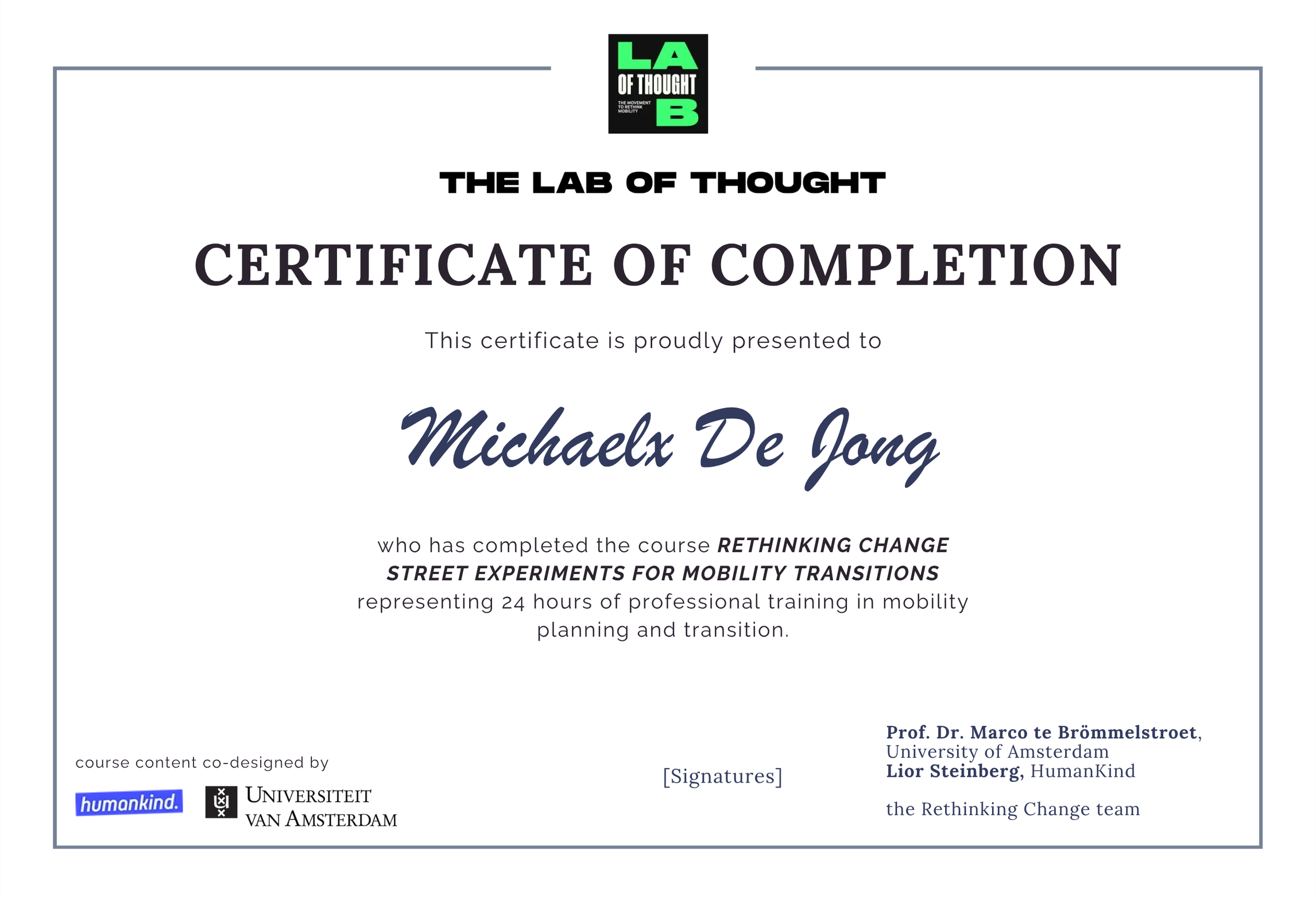
You receive a certificate after completing the course.